
In Poker, players are not always dealt strong starting hands like AA, KK, or AK. In reality, most of the time you will face weak starting hands, commonly known as trash hands. This situation can be frustrating, especially for beginners.
However, according to experienced players at My88, understanding trash hand in Poker not only helps reduce unnecessary losses but also allows you to turn seemingly weak situations into strategic opportunities. This article will explain what trash hands are, how to recognize them, and effective ways to manage them.
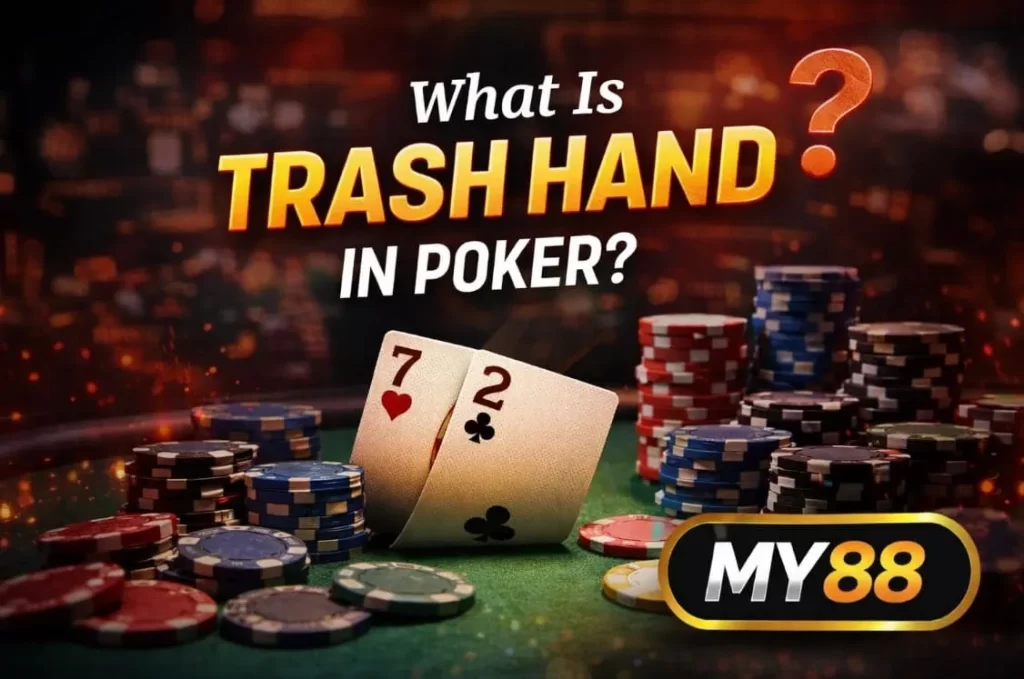
What Is a Trash Hand in Poker?
Trash Hand in Poker refers to a starting hand with very low value and little potential to form strong combinations. Examples include:
- 2 – 7 offsuit
- 3 – 8
- 4 – 9
- Cards that are not consecutive and not of the same suit
These types of hands rarely develop into strong combinations such as a straight, flush, or strong pair. Because of this, players who do not fold early often risk losing chips quickly.
However, experienced My88 players know that holding a trash hand does not always mean you must fold immediately. In certain situations, smart strategy can still help you control the hand effectively.
Why Players Should Understand Trash Hands
Understanding trash hands is essential for improving Poker skills and minimizing unnecessary losses during gameplay.
Proper Understanding of Trash Hands
Trash hands are starting combinations that have very little chance of forming powerful Poker hands. Examples include hands like 7-2 offsuit, 8-3, or 9-4, which are generally considered weak because they rarely connect to form straights or strong pairs.
In Poker, receiving weak hands is completely normal since the game heavily depends on probability. No player gets premium cards all the time. Therefore, recognizing trash hands and learning how to deal with them wisely is an important part of mastering the game.
Avoiding Unnecessary Losses
One major reason players need to recognize trash hand in Poker is to avoid wasting money. Many beginners tend to “play by luck”, continuing to bet even when their cards are very weak. This often leads to falling into opponents’ traps or investing chips in hands with almost no winning potential.
By identifying trash hands early, players can fold at the right moment, preserving their chips and waiting for stronger opportunities in later rounds.
Building a Smarter Strategy
Understanding weak hands also helps players develop better strategies. Skilled players usually participate only in hands with higher winning potential. They know when to stay in a hand and when it is better to step away.
Additionally, knowledge of trash hands allows players to apply bluffing strategies in appropriate situations. If you can read the table and analyze your opponents correctly, even a weak hand can occasionally turn into a winning opportunity. However, this approach requires experience and good emotional control.
Better Bankroll Management
Poker is not just about luck; it is also a game of financial discipline and bankroll management. Players who understand the value of different hands can allocate their chips wisely and avoid placing large bets on weak holdings.
Continuing to bet aggressively with trash hand in poker can quickly damage your bankroll. On the other hand, folding early can help preserve your funds and increase your chances of winning important hands later in the game.
Common Types of Trash Hand in Poker According to My88
Recognizing common types of trash hands helps players make smarter decisions and avoid unnecessary chip losses. Based on experience shared by My88, these are the most frequently encountered weak starting hands in Poker.
Unconnected Cards
This is one of the most common types of trash hand in poker. These cards have no numerical connection, making it extremely difficult to form a straight. Examples include hands such as 2 and 8, 3 and 9, or 4 and J.
These combinations are not only unlikely to form straights but also rarely create strong pairs. If one card does pair with the board, it is often a low pair that can easily be beaten by stronger hands. Therefore, players should often consider folding these hands early.
Offsuit Cards With Low Value
Another common trash hand category involves two low cards of different suits, such as 2-7, 3-8, or 4-9. Because they are not suited, they cannot form a flush. At the same time, the large gap between the card values makes it difficult to complete a straight. Continuing to play these hands often places players at a disadvantage against opponents holding stronger cards.
High Cards That Are Not Suited
Some beginners believe that hands like K-7, Q-4, or J-8 are strong simply because they contain a high card. In reality, if these cards are not suited and do not connect, their potential remains limited. Even if the high card forms a pair, opponents may still have stronger pairs or better combinations such as two pairs or straights.
Cards That Are Too Far Apart
Hands with large gaps between card values, such as 2-K, 3-Q, or 4-A, are also considered trash hands in many situations. The wide gap between the cards makes forming a straight nearly impossible. Even when one card pairs with the board, it may still be too weak to compete with stronger hands at the table.
Low Suited Cards With Limited Potential
Some suited hands like 2-5 suited or 3-7 suited might appear promising because they could potentially form a flush. However, their low values often make them weak overall.
Even if a flush is completed, there is still a risk of losing to a higher flush. Therefore, these hands should only be played in special situations or when the player has a favorable table position.
Effective Ways to Handle Trash Hand in Poker at My88
Knowing how to manage trash hands is an essential skill in Poker. It helps players minimize losses and maintain a long-term advantage at the table. Based on experience from My88, the following Poker tips can help you handle weak hands more effectively and make smarter decisions during the game.
Know When to Fold Early
The most important strategy when holding a trash hand is folding at the right time. Many beginners try to stay in the hand hoping the situation will improve in later rounds. Unfortunately, this often leads to losing more chips while the chances of winning remain very small.
If your starting hand has little potential to create strong combinations like straights, flushes, or high pairs, folding early is often the safest choice to protect your bankroll.
Pay Attention to Table Position
In Poker, table position plays a significant role in how you should handle weak hands. Players who act later in a betting round have more information because they can observe the actions of opponents before making decisions. This allows them to evaluate the strength of other players’ hands and determine whether continuing with a weak hand is worth the risk. Sometimes, if all players before you check or place small bets, a late-position player may even take advantage of the situation to bluff and win the pot.
Use Bluffing Strategically
Bluffing is a common tactic in Poker and can occasionally turn a weak hand into a winning one. However, bluffing should be used carefully and at the right moment. Based on My88 player experience, bluffing works best when there are fewer opponents in the hand and when you have built a tight playing image at the table. In such situations, other players are more likely to believe that you are holding a strong hand.
Manage Your Bankroll With Weak Hands
A common mistake among many players is betting too aggressively while holding trash hands, which can quickly drain their bankroll. Instead, players should adopt a strategy of small bets or folding quickly when holding weak cards. Proper bankroll management helps extend your playing time and gives you more opportunities to win stronger hands in later rounds.
Take Advantage of Opponent Information
Even when you have a trash hand in poker, you can still use the information gathered from your opponents’ behavior to make better decisions. For example, if an opponent usually bets aggressively but suddenly checks, it may indicate that their hand is not very strong.
By observing betting patterns, reaction speed, and playing habits, you can better understand the table dynamics and occasionally turn weak hands into strategic advantages.
Conclusion
Understanding trash hand in Poker is an essential step toward improving your skills and reducing risks. Instead of trying to play every hand, successful players know when to fold, when to bluff, and how to manage their bankroll effectively.
By mastering these concepts and strategies, you can transform difficult situations into learning opportunities and gradually become a stronger Poker player. If you want to explore more professional Poker tips and strategies, try playing at My88 to enhance your experience and skills at the table.
